An Appeal to the Shankaracharyas
Sastrigal was also realistic about the scale of the task.His Kalady Bhagavatpada Kainkarya Dharma Sabha, however dedicated, could not indefinitely bear the organisational and financial burden of such an undertaking. He therefore appealed directly to the Shankaracharyas for their active involvement. He requested the Shankara Mutts to send official representatives to participate in the annual festival. He sought financial assistance for particular days of the celebrations and requested that the expenses involved in honouring the distinguished scholars attending the gathering be shared. But his most important request concerned the future of the birthplace itself.
A Temple at the Birthplace
Sastrigal urged the Shankaracharyas to come together and take the initiative for the construction and consecration of a proper temple at Kalady. He respectfully requested them to send a Srimukham, together with their contribution, either to him or to the secretary of the committee at Parur, so that the work already begun could continue and grow.
The February 1902 appeal is therefore an important historical document. It records Kalady at a crucial stage in its modern history: the birthplace had been identified and Sri Shankara Jayanthi celebrations had already begun there, with the blessings of the Sringeri Shankaracharya, but the place was still neglected and the local movement was struggling for wider institutional recognition and support.
More importantly, this is not a story reconstructed many decades afterwards. Sastrigal himself published the appeal in his own Brahmavidya in February 1902, while the movement to revive Kalady was actually taking place. It preserves, in his own time, what had already been accomplished, the difficulties being faced, and his vision for what Kalady could become.
A Life Devoted to Kalady
Nadukkaveri Srinivasa Sastrigal did not merely write about the forgotten birthplace.
He went to Kalady.
He brought people to Kalady.
He organised Sri Shankara Jayanthi there.
His efforts received the blessings of the Sringeri Shankaracharya.
He appealed to the Shankaracharyas and religious institutions for wider support.
And he continued this work until his death in September 1911.
Today, Kalady is known throughout India and beyond as the birthplace of Sri Shankara Bhagavatpadacharya. It is therefore worth returning to the contemporary records of the years when that recognition was still being painstakingly rebuilt.
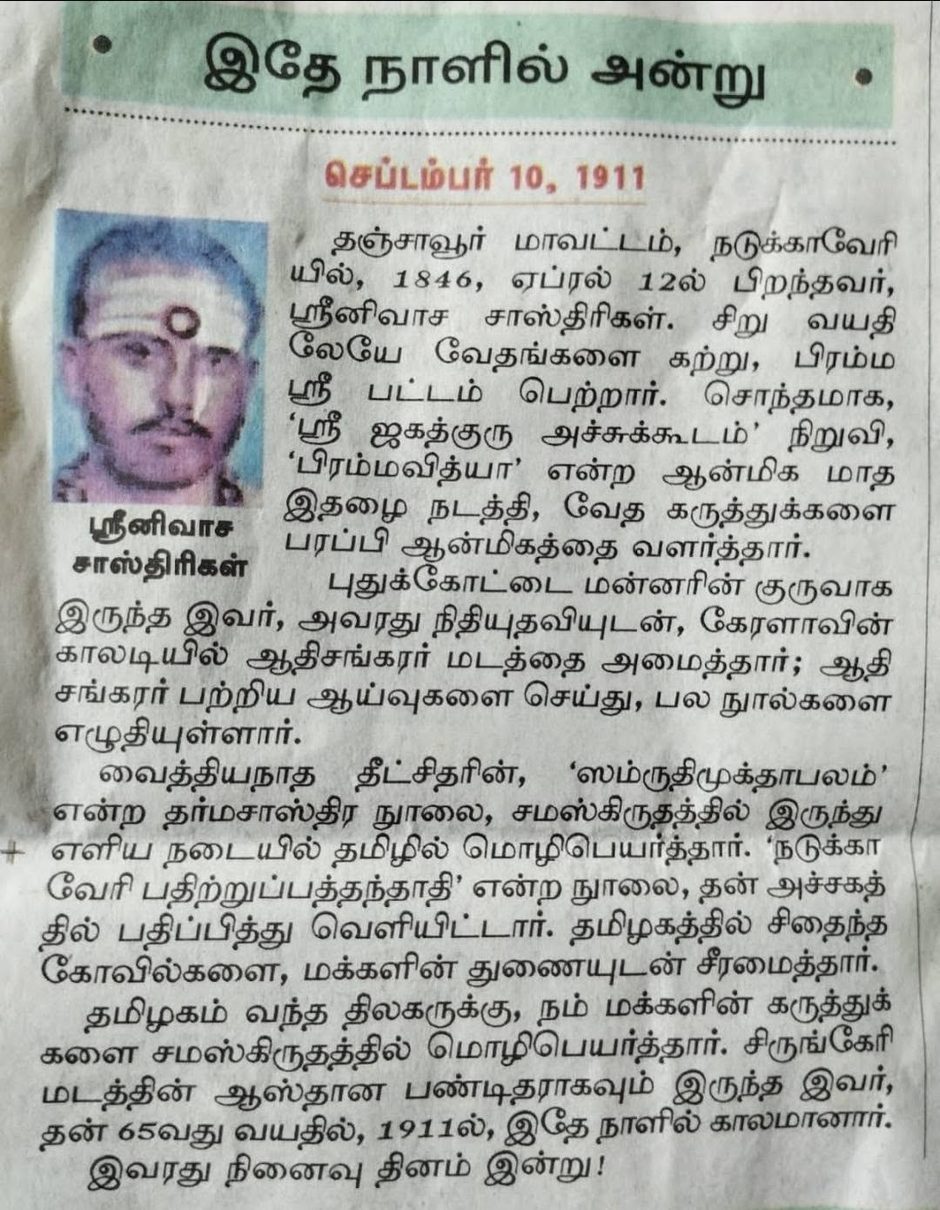
On September 10, the memorial day of Nadukkaveri Srinivasa Sastrigal, the old newspaper reports from 1897 to 1911, together with his February 1902 appeal published in Brahmavidya, deserve to be read again.
They tell the story of a scholar who saw a sacred place lying forgotten, refused to allow it to remain so, and devoted years of his life to bringing Kalady back into the religious consciousness of the country.
(Concluded)