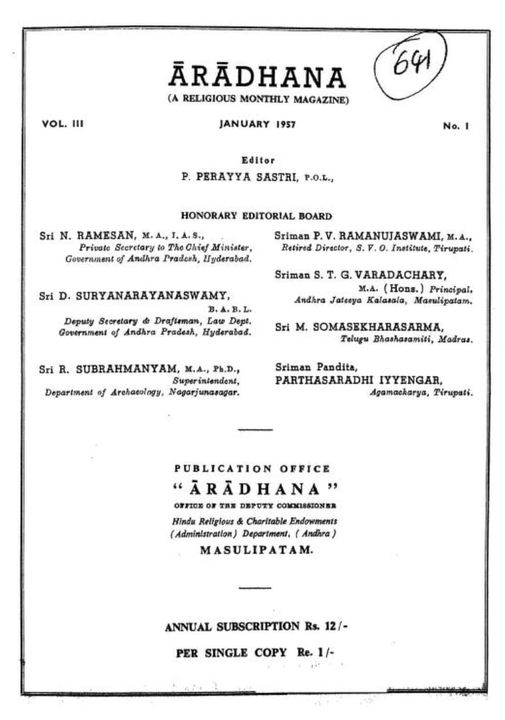
ARADHANA, Monthly Magazine of the Hindu Religious And Charitable Endowments Dept. Andhra, Vol.3, 1957

ఆరాధన సంపుటము 3, 1957

by పి పేరయ్యశాస్త్రి(సం.)

(ARADHANA, Monthly Magazine of the Hindu Religious And Charitable Endowments Dept. Andhra, Vol.3, 1957)

SOURCES FOR SANKARACHARYA’S LIFE… 1

The sources for the life of Sankara Bhagavadpadacharya are very scanty and meagre, as is the case with almost the life of every early great Indian.

Sankaracharya himself was a great writer, and has left us a remarkable collection of writings, which reflect the power of his thought, and the greatness of his conception.

The most noteworthy of His works, are his classic commentaries on the Brahma Sutras, the Gita, and the Upanishads. The Upadesha Sahasri’ and “Vivekachudamani’ are composite works by Sankaracharya, which reflect His general tenets. But unfortunately for us, these works of the master, do not contain much of useful biographical material. We have, therefore, mainly to depend upon the works of His disciples.

A number of biographies of Sankaracharya, called ‘Sankara Vijayas’ have been written by his disciples, the most important of them being Madhava’s “Sankara Digvijaya” and Anandagiri’s “Sankara vijaya”.

….

Anandagiri’s biography is generally held to be the most authoritative. Anandagiri is held to be the same as “Thotakacharya’ who was one of the four important disciples of Sankaracharya.

‘Advaita Samrajya Lakshimi,’ a commentator upon the Madhaveeya Sankara Vijaya, holds that Anandagiri was a direct and dear disciple of Sri Sankaracharya. He says:

” शङ्करस्य भगवतो भाष्यकारस्यायं शाङ्करः आनन्दगिर्यभिधः तस्य तत्प्रियशिष्यस्य वाक्यसारः”

The Dindima commentary on the Madhaveeya Sankara Vijaya gives a list of the prominent disciples of Sri Sankaracharya as following :

” अथ अनन्तरं पद्मपाद, हस्तामलक, समित्पाणि, चिद्विलास, विज्ञानकन्द, विष्णुगुप्त, शुद्धकीर्ति, भानुमरीचि, कृष्णदर्शन, बुद्धिवृद्धि, विरिधिपाद, शुद्धानन्द,गिरिप्रमुखैः”

Anandagiri’s Sankara Vijaya also gives the same list of the disciples in the following words: G”पद्भपाद, हस्तामलक, समित्पाणि, चिद्विलास, विज्ञानकन्द विष्णुगुप्त, युद्धकीर्ति, भानु मरीचि, कृष्णदर्शन, बुद्धिवृद्धि, विरिविपाद, शुद्धानन्द, गिरिप्रमुखैः”

So, we may assume that Anandagiri was a contemporaneous and direct disciple of Sri Sankaracharya and that his biography would contain the most accurate information about the life of the great Acharya.
The Journal of the Royal Asiatic Society (Jan.1918)

COPPER-PLATE INSCRIPTIONS BELONGING TO THE SRI SANKARACHARYA OF THE KAMAKOTI-PITHA. Edited By T. A. GOPINATHA RAO, M.A. Madras, (1917) – Book Review By L.D. BARNETT

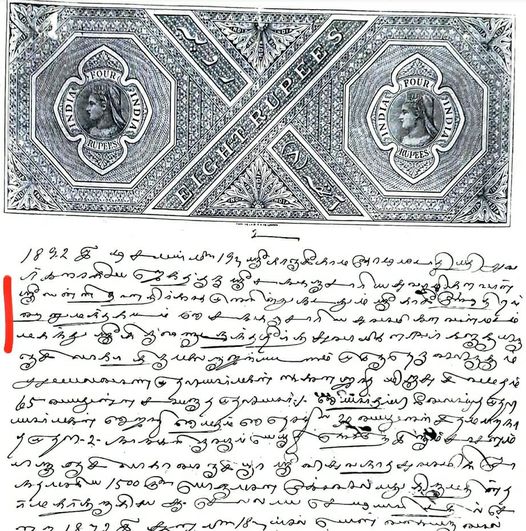
In this volume Mr. Gopinatha Rao gives the text and translation of ten grants engraved on copper-plates, which belong to the monastery at Kumbakonam, known as the Kama-kōti-pitha, one of the establishments claiming descent from the great Sankaracharya.

The documents comprise grants of Vijaya-ganda-gopala (circa A.D. 1260),

Vira Narasimhha-deva (Saka 1429), Krishna-deva-rāya (Saka 1444 and 1450),

Vijaya Raghunatha Tondaiman of Pudukōṭṭai (Saka 1613), Vijayaranga Chokkanatha Nayanayyavaru (Saka 1630), and one of the Emperors of Delhi (Hijra 1088), together with a fragment of a grant issued by one of the Vijayanagara kings of the last dynasty and a document of Saka 1608, which is interesting from its mention of Akkanna and Madanna, the notorious favourites of the Kutb Shahi Sultan Abu’l-Hasan of Golkonda.

They are in Sanskrit, Tamil, Telugu, and even (in the case of the Delhi firman) Persian transliterated into the Telugu character.

In our opinion the editor would have done well to transcribe each document in the script in which it is actually written, or else into Roman; instead of doing so, however, he has given alike the Sanskrit, the Telugu, and the Persian in Nagari character. In defence of this course he may plead the example of certain distinguished writers in the Epigraphia Indica; but two blacks do not make a white, and the transliteration of a complicated Southern alphabet like Telugu into such a disparate script as Nagari leads to most unhappy results.

Apart from this minor point, the work is carefully and correctly done-perhaps a little too correctly, for the learned editor has given in his notes the correct forms for all vulgar and archaic spellings, which is hardly necessary in every case and is illustrated by good plates. The only real desideratum is an index.

L. D. BARNETT.

Sri Sankaracharya’s connection with Varanasi..2

(Contd.) Further even today there exists a Matha by name Sumeru Matha (also known as Paduka Matha) in Varanasi.

It has a distinct code (Mathamnaya) of its own. In an appeal for funds, for carrying out repairs of the Matha issued on behalf of this institution several years ago, it is stated that during his stay at the holy City of Kasi Paramahamsa Parivrajakacharya Jagadguru Adi Sankaracharya Maharaj established the Sumeru Math.’

Among the signatories in this appeal the names of the Heads of the Omkar Matha and Dattatreya Matha, the Mahants of the Visvesvar and Annapurani Temples, four distinguished scholars with the title of Mahamahopadhyaya, the Private Secretary of the Maharajah of Benares, many other Scholars, Officers, Zamindars etc., are seen.

In this connection it may be remembered that in Mathamnayas, the Matha for Urdhvamnaya is given as Sumeru Matha’, its Sampradaya as Kashi Sampradaya and kshetra (location) as Kaivalya-Kshetra (meaning thereby the place of liberation-Kashi being the foremost of the seven sacred cities of liberation or Mokshapuris of our land).

Among the other details given in Mathamnaya works occur the phrases: ‘शुकवामदेवादि – जीवन्मुक्तानां सुसंवेदप्रपठनं etc.

Some of ancient title records of the Vanjiyur Sri Viswanatha Swamy Devasthanam estates belonging to the Kanchi Matha, evidence the existence of a Branch matha of Kanchi Kamakoti Peetha in the Hanuman Ghat,

Kashi and also the details of the mahant (sanyasi disciple) who was the in charge of the Varanasi Branch matha (also known as Sukadeva Matha).

With the laudable idea of fittingly commemorating the stay of Sri Sankara Bhagavadpada in the Holy Varanasi, the spiritual capital of Bharat, Sri Sankaracharya of Kanchi Kamakoti Moolamnaya Sarvajna Peetha performed the Kumbhabhishekam of the newly constructed Kamakotisvara and Panchayatana Mandir at Kashi on 28th January 1974.

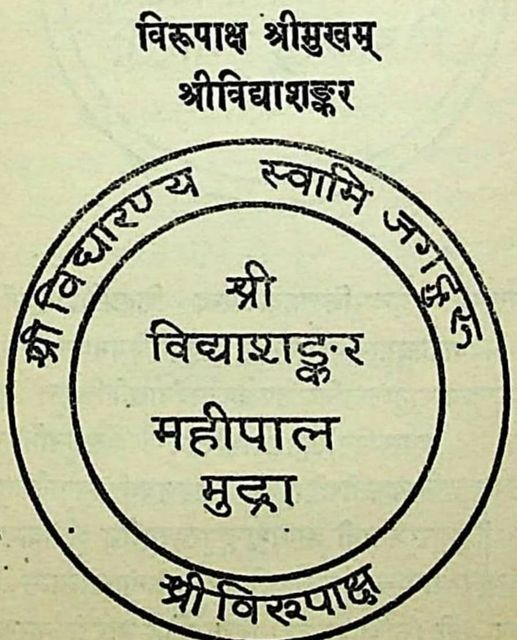
(Hampi) Virupaksha Sringeri Matha – Succession List

The succession list of Jagadguru Acharyas of (Hampi) Virupaksha Sringeri Matha … 1

Sri Sankara Bhagavadpadacharya

I

1. Sri Vidyaranya Swami (Veda Bhashyakara)

(founder of Virupaksha Sringeri Matha)

2. Narasimha Bharati I.. (Saka 1300- 1315)

3. Surendra Bharati.. (Saka 1314-1328)

4. Sankara Bharati I.. (Saka 1332-1350)

5. Narasimha Bharati II .. (Saka 1342-1353)

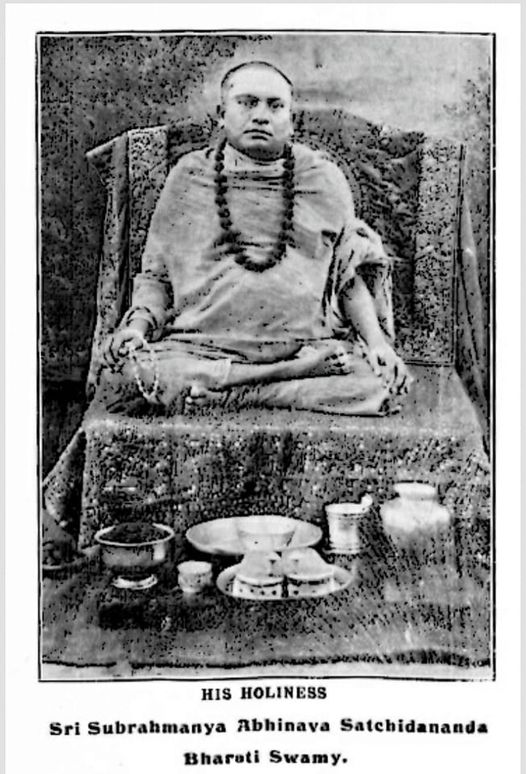
6. Sachchidananda Bharati .. (Saka 1355-1368)

7. Sankara Bharati II… (Saka 1370-1385)

8. Vidyaranya Bharati I.. (Saka 1390-1398)

9. Narasimha Bharati III.. (Saka 1398-1408)

10.Sankara Bharati II.. (Saka 1408-1420)

11. Sachchidananda Bharati.. (Saka 1421-1435)

12. Vidyaranya Bharati Il .. (Saka 1436-1456)

13. Sankara Bharati IV.. (Saka 1456-1476)

14. Sachchidananda Bharati III… (Saka 1470-1478)

15. Sadananda Bharati.. (Saka 1478-1488)

16. Sankara Bharati V… (Saka 1488-1493)

17. Narasimha Bharati IV.. (Saka 1494-1504)

18. Vidyaranya Bharati III ..(Saka 1505-1514)

19. Vidya Narasimha Bharati.. (Saka 1515-1523)

(Source: Epigraphical Glossary on D. Inscriptions By Prof. V.Vijayaraghavacarya,1938)

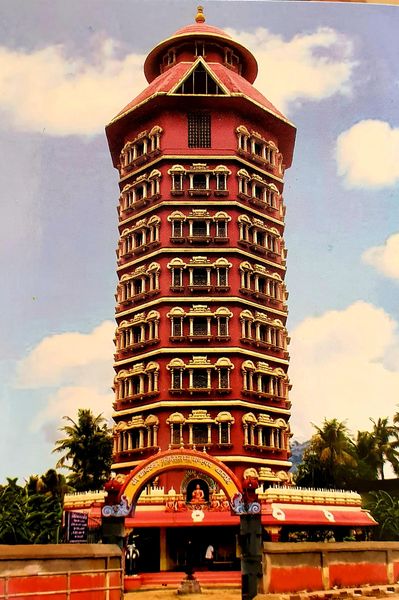
SRI KANCHI KAMAKOTI PEETAM SRI SANKARA BHAGAVATPADA KEERTI STHAMBHAM, KALADY, KERALA

SRI KANCHI KAMAKOTI PEETAM SRI SANKARA BHAGAVATPADA KEERTI STHAMBHAM, KALADY, KERALA

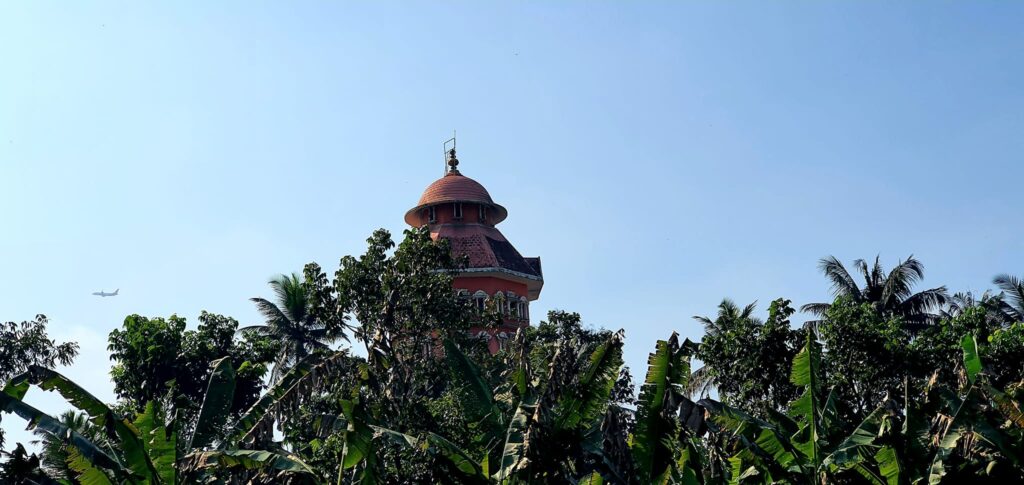
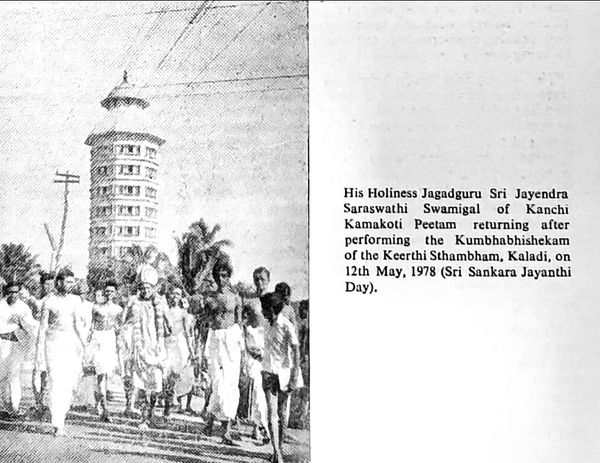
The tallest religious monument of Kerala, the Sri Adi Sankara Bhagavadpada Keerti Sthambham , rising to a dizzy height of 152 feet to perpetuate the memory of the Saint, who was born at Kaladi to rise to the pinnacle of glory and to place the resuscitated Hinduism on its solid pedestal, overlooks the sacred spots of the village, associated with Sri Adi Sankaracharya’s life.

From the top of the nine-storey structure an imposing eight-foot statue of the Saint with his four disciples looks down on the sprawling carpet of green beneath, the shadowy valleys of Ghats merging with the margins of the distant horizon and the proud Periyar river still washing the feet of the village with the brimming irrigation canals, criss-crossing the countryside to bring life to the parched land.

The exquisitely built reinforced concrete structure represents a harmonious blending of the concepts of modern architecture with the prescription of the scriptures and traditions and the stipulations of Silpasastra.

The temple architecture traditions of Kerala and Tamil Nadu have also been blended judiciously. The seasoned masons of Kerala and a good number of young workers, men and women, worked with fervour for about two years to give concrete shape to the tower, while the deft hands of the artists from Tamil Nadu drew poems on Sri Sankarachaya’s life in cement for the ornamental work.

Though originally conceived to be 85 feet tall, which incidentally coincided with the 85th year of the Jagadguru of Kanchi Kamakoti Mutt, His Holiness Sri Chandrasekharendra Saraswathi Sankaracharya Swamigal, the architectural and engineering require ments and the aesthetic compulsions finally raised it to over 150 feet, more than double the 60 feet diameter of the basement.

Among the latest in the series of Sri Sankaracharya monuments built under the auspices of the Kanchi Mutt in different parts of India and Nepal, the Kaladi tower costing Rs. 20 lakhs, is one of the tallest so far. The other memorials are at Kanchipuram, Kurukshetra, Haridwar, Puri, Madhyarjunam, Jambukeswaram, Rameswaram, Kanyakumari, Srisailam, Tirupati, Tryambaka, Lakshmanjhula, Badari, Kedara, Khatmandu, Prayaga and Kashi.

Though it can still be called a religious monument, the concept and the execution of the Kaladi tower are essentially secular. Basically, it is only a memorial dedicated to the greatest son Kerala has ever produced. There is nothing of a temple or place of worship in the stupa.

The life story of Sri Sankaracharya and the huge figures of Gods and Goddesses installed on the different floors may still make it look like a temple. But the difference is brought home by the fact that the figures and relief work were all done in cement as distinct from granite, the usual medium for the temples.

It is just another instance of the harmony -a secularist memorial to a religious genius, to whom the country owes a good deal. Its utility too can be very secularist in nature, for it can be developed into a centre of Vedic learning, a place of tourist attraction, a deserving monument to an epoch in history, when the genius of India found expression. A small shrine built beside the stupa could grow into a focus of religious worship.

The marvel of the Saint’s life starts strik ing the visitor as soon as he steps on to the basement of the tower where the ‘Padma paduka’ in marble is installed. Then as you ascend the winding stairs the story of the genius and his ascension to the pinnacle unfolds itself before you in the form of 49 panels of mural relief.

The flight of steps lead you to a lofty world, far above and away from the base to the Sankarapattabhisheka and finally to the imposing figures of the Saint and his disciples, overlooking the world beneath, with Dakshinamurthi in the background as mural relief.

As you go past the floors, the huge figures of the ‘Gitopadesa’, Vinayaka, Muruga, Surya, Mahavishnu, Kamakshi and the colossal Sivalinga, make your climb a pilgrimage, a spiritual and an aesthetic experience. And you never realize that you have climbed 150 feet.

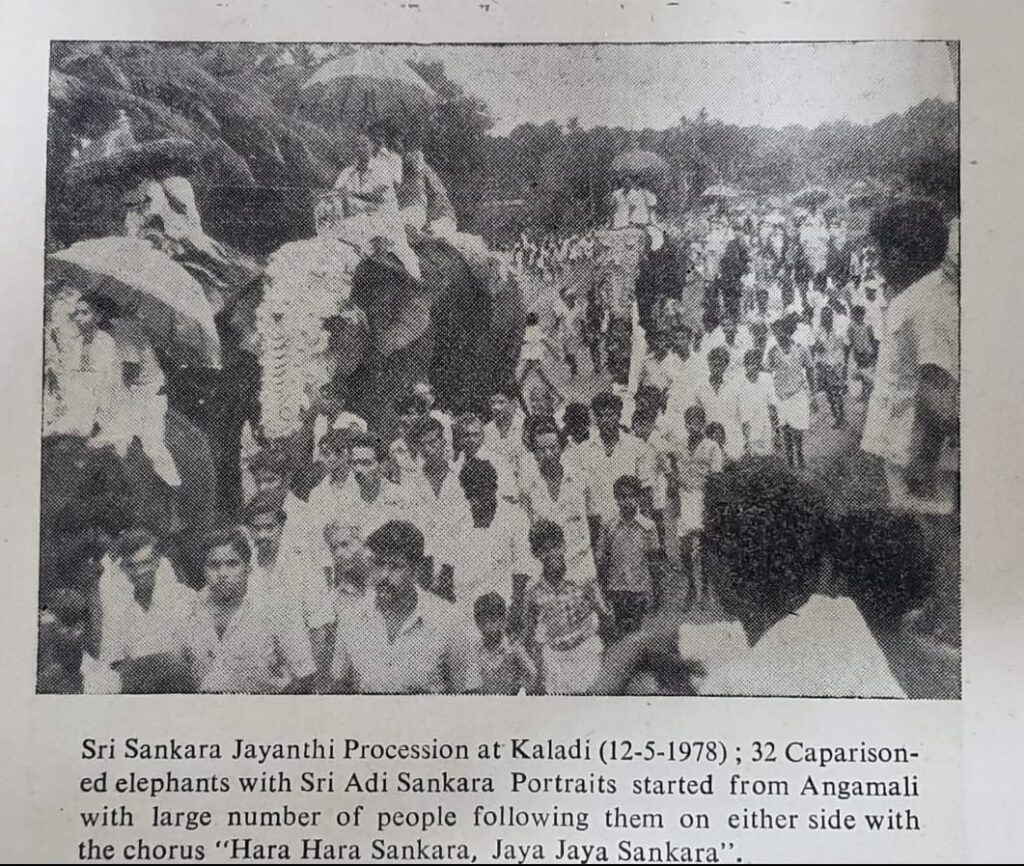
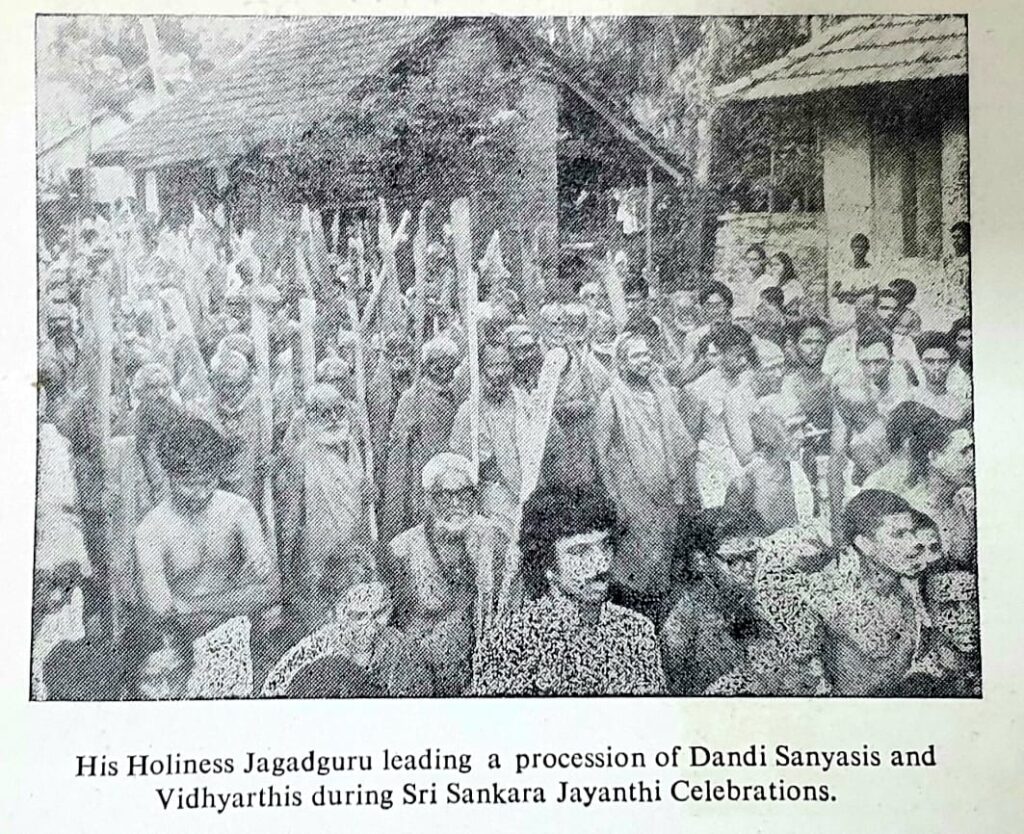
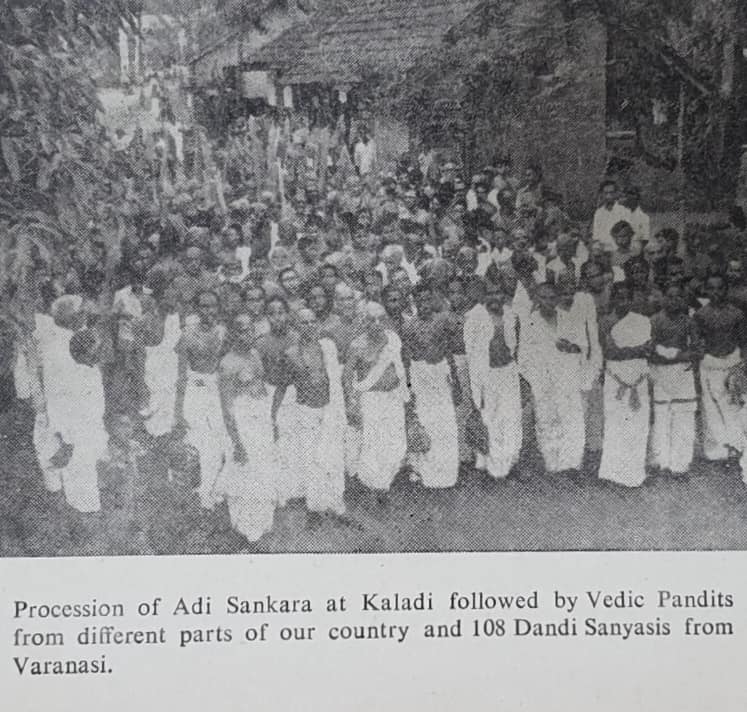
Jagadguru Sri Jayendra Saraswathi Sankaracharya Swamigal of Sri Kanchi Kamakoti Peetam arrived at Kaladi on May 6, 1978, and stayed there till May 18, in connection with the Samprokshanam of the Stupa, which took place on May 12 (Sri Sankara Jayanthi Day).

Sri Sankaracharya stayed at the Manikkamangalam Devi Temple, where the father of Sri Adi Sankara was the chief priest, and performed Sri Sankara Jayanthi Celebrations.

– P. Aravindakshan (1979)