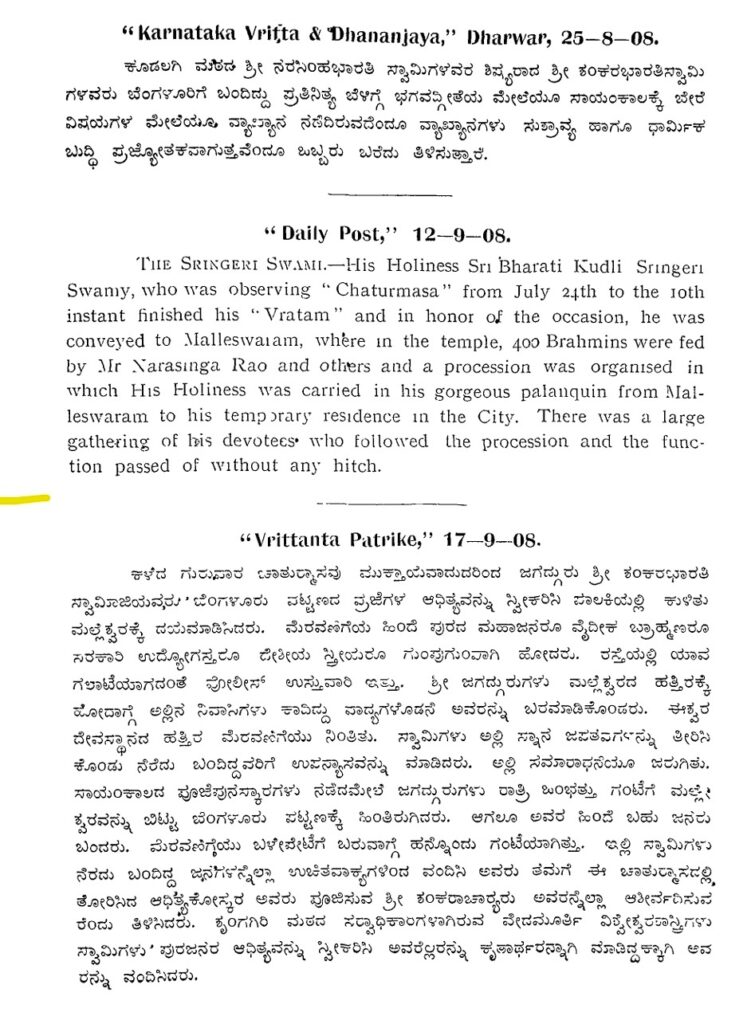
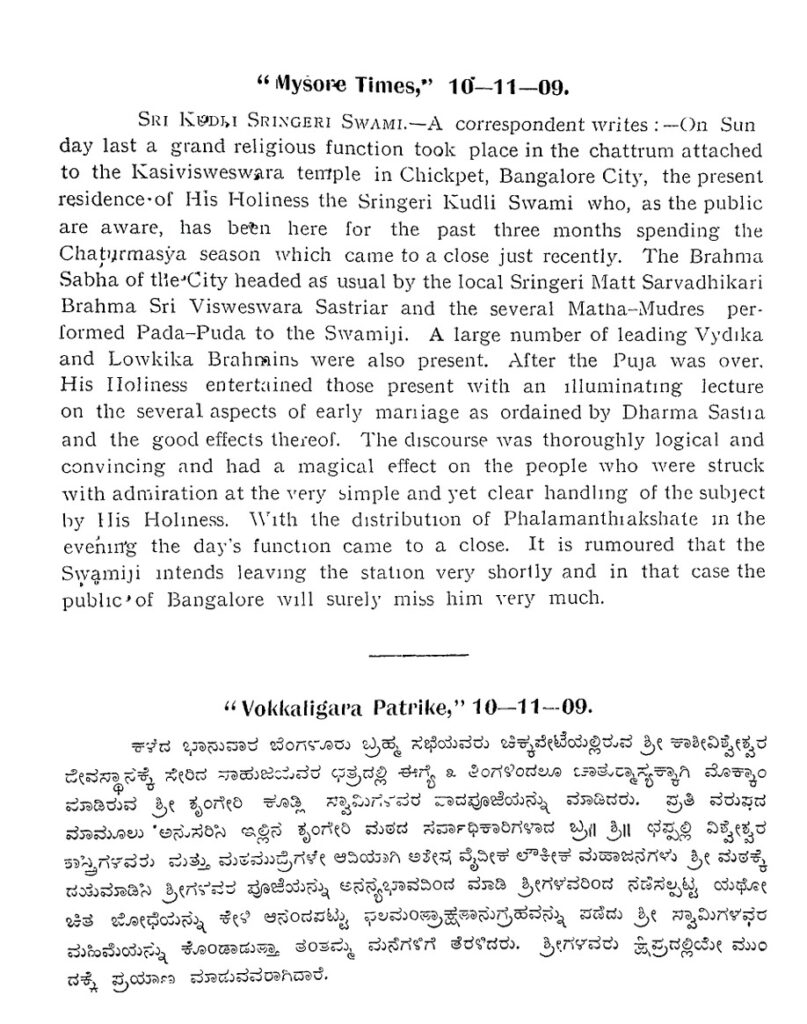
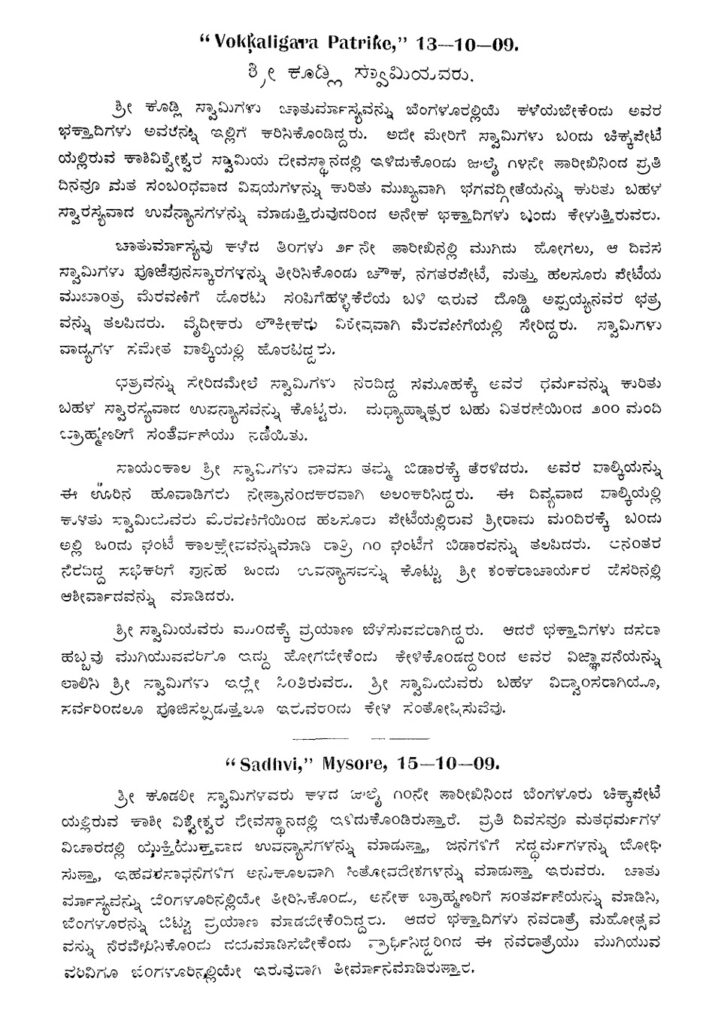
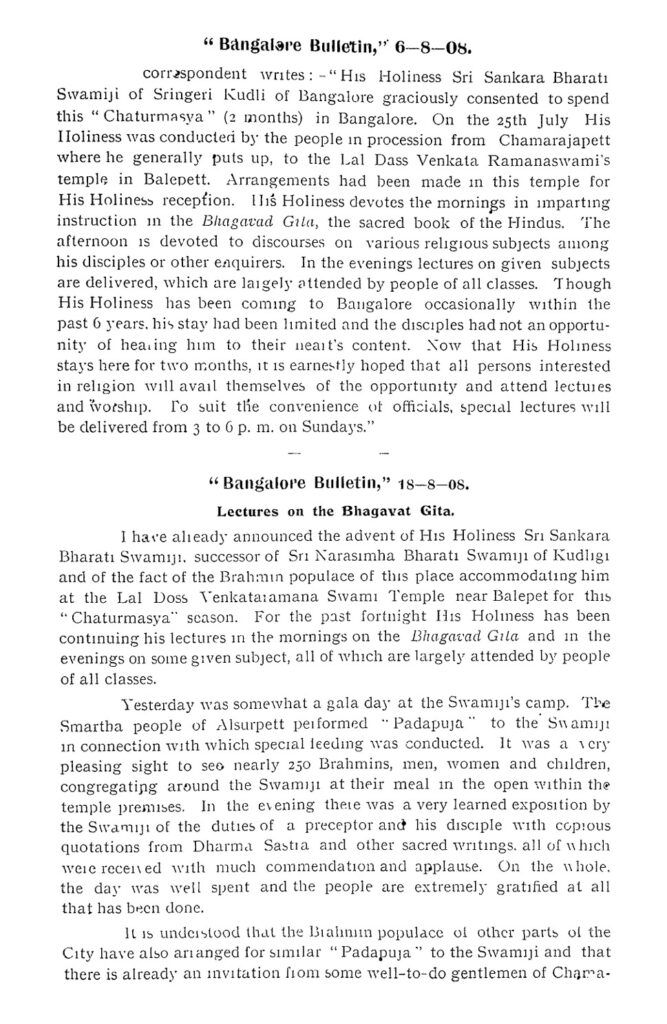
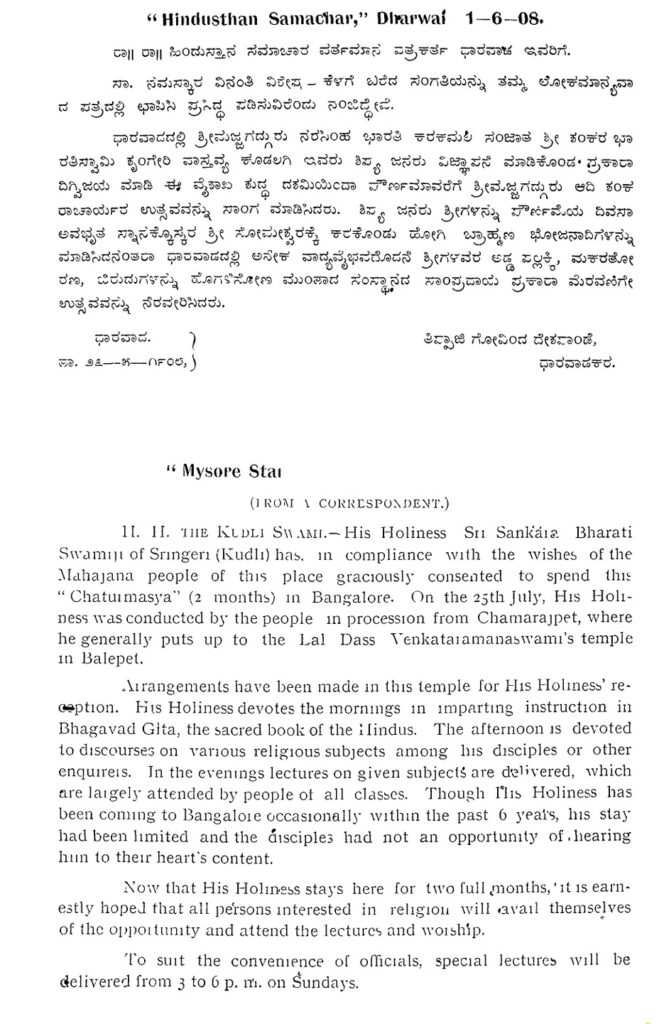
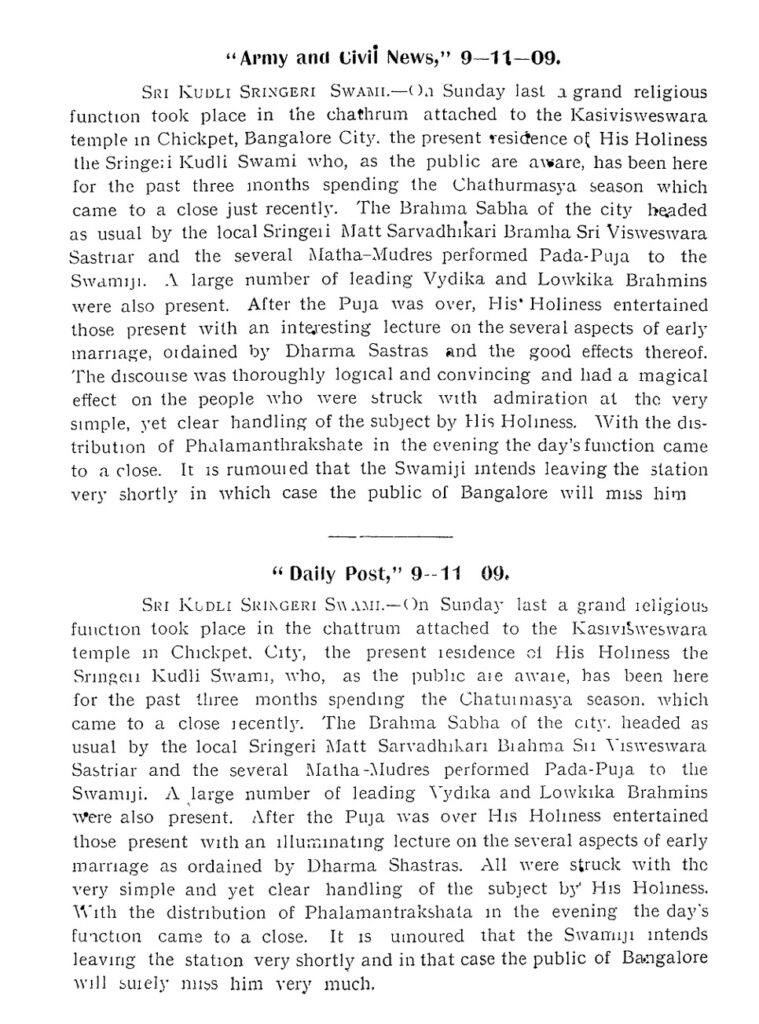
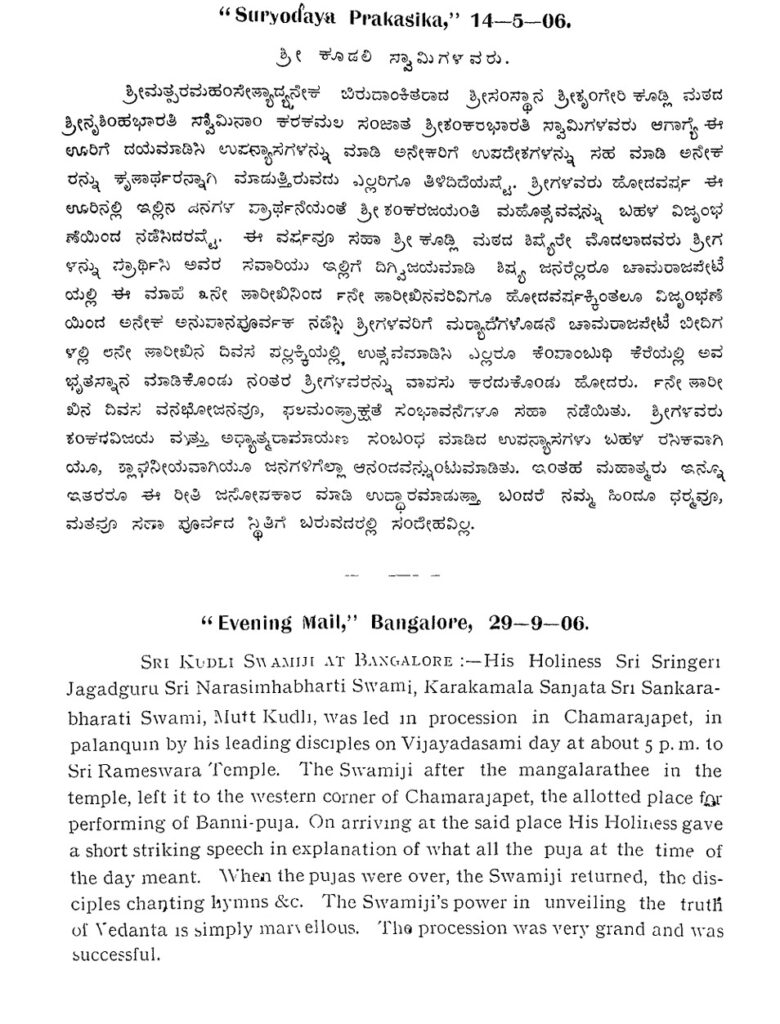
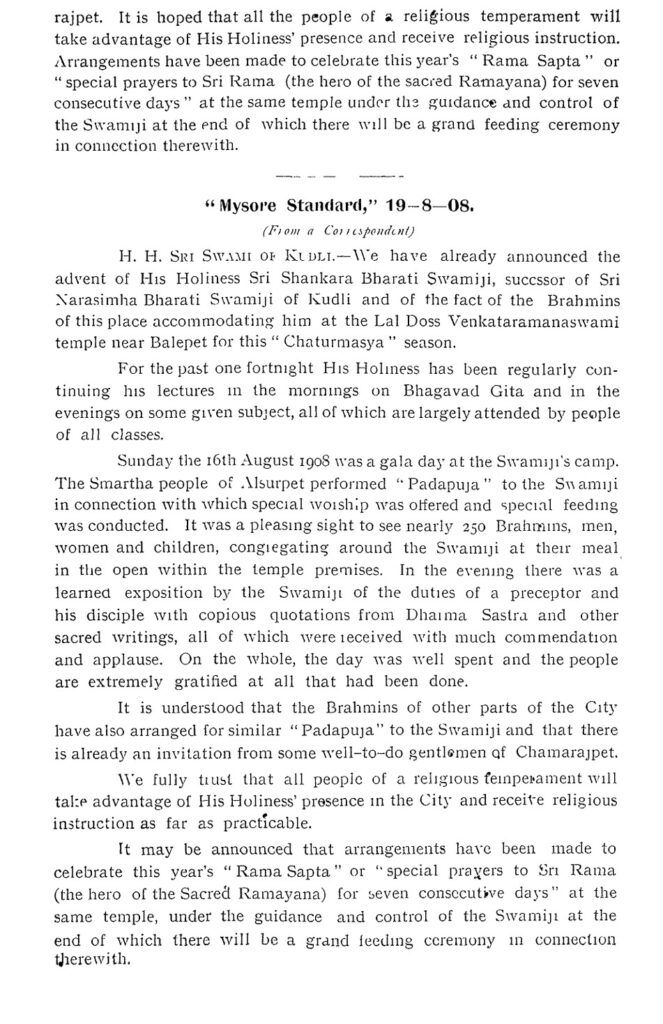
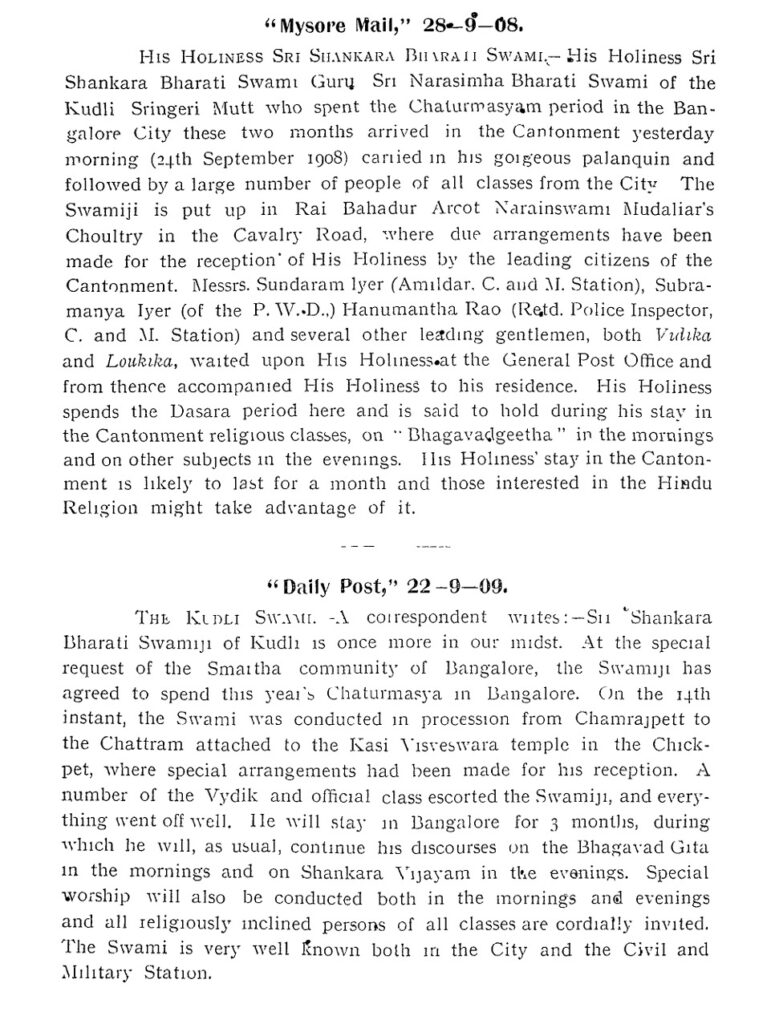
This Rahadari order dated 19 June 1926, issued by the Government of Madras, records the Vijaya Yatra of Jagadguru Shri Shankaracharya Swami of Hariharapuram Matha to Rameswaram. It directed the district authorities to facilitate the journey and ensure that no obstruction was caused to the Swami and His followers.
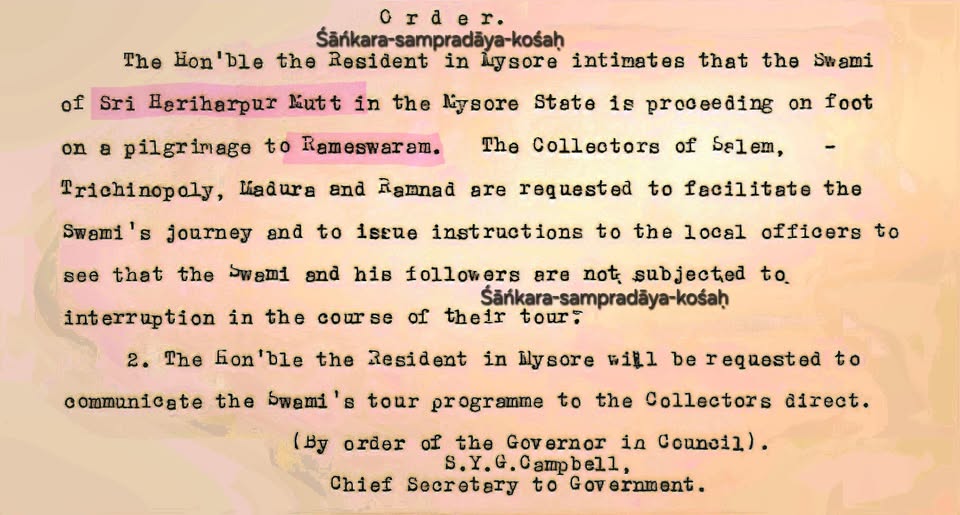
Srimat Paramahamsa Parivrajakāchāryavarya – Chief Acharya of the Paramahamsa Sanyasis,
Padavākya-Pramana Pārāvāra Pārina – Who has been to the farthest point of grammar, philosophy and logic,
Yamaniyamāsana Prānāyāma Pratyāhāra dhyāna dhārana Samādhyaştanga Yogācharana niruta – Engaged in the performance of eight-fold yoga consisting of restraint, control of passions, sitting in different postures, control of breath, withdrawing the mind from external objects, meditation, control of mind and absorption of the mind in God,
tapahśchakravarti – An Emperor of Austerities,
anādyavicchinna guruparamparāprāpta – A lineal descendent of the gurus from time immemorial without break,
Sakala nigamāgama Sārahridaya Sānkhyatrayapratipādaka – Teacher of the inner truth and essence of all vedas and agamas and the three sankhyas,
Vaidikamārga Pravartaka – Establisher of the vedic doctrine,
Saravatantra Svatantra – Master of all the tantras,
ādirājadhāni Vidyānagara Mahārājadhāni – Vidyānagara, the first-great capital,
Vaibhava Simhāsanādhiśvara (Lord of the renowned throne,
Vyākhyāna Simhāsanārūda – seated on the Vyakhyana Simhāsana, throne of scripture,
Srimadrājādhiraja guru – Preceptor of the kind of kings,
Gokarna Mandalāchārya – Preceptor of Gokarna Mandala,
Śrimachhataśrunga Purvarādhiśvara (lord of Śringapura,
Śrimachhrāvati Tirvāsā – Resident on the bank of the river Sarāvati,
Śrīrāmachandra Pädapadmarādhaka- worshipper of the lotus feet of Sri Ramachandra.
(Source: Sri Ramachandrapuram Math : Its History And Antiquities By Research Scholar T.S. Halemane, 1999.)
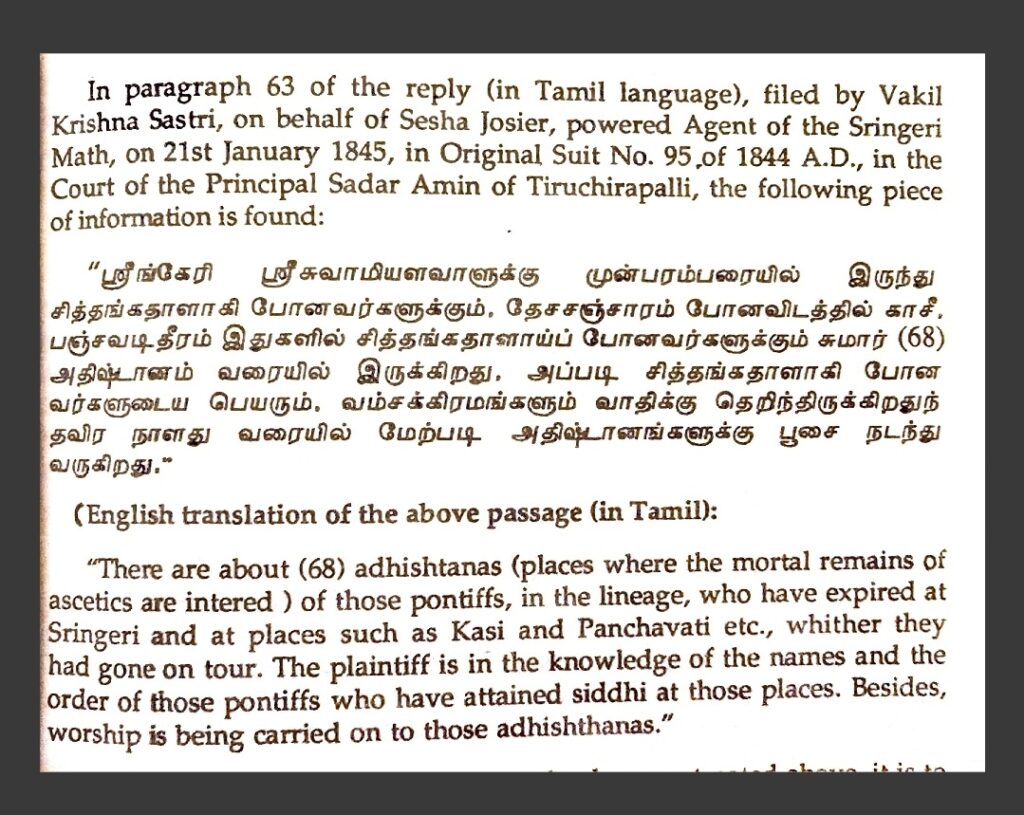
In the 1844 Tatanka Pratishta case, on behalf of the petitioner-Tunga matha, it was stated that one of their Poorvacharyas had attained samadhi at Kashi.
Which Acharya of the Tunga Matha was stated to have attained samadhi at Kashi and on what basis this information was submitted before the Court by their Agent?
Although the Vidyashankara temple is commonly assigned to the14th century, Amita Kanekar’s architectural study shows that such an early date is inconsistent with its design which clearly points to a later period.
The temple’s core structure is firmly in the Dravida (Tamil) style, with pillars and hall elements characteristic of the Keladi Nayaka and Vijayanagara tradition of the 16th century. However, the Hoysala-looking exterior is a conscious archaic revival, not an actual work of the Hoysala-era. There is no Bijapur Sultanate influence in its construction.
All these would confirm that the Vidya shankara temple at Tunga Sringeri was erected before the post-1565 rise of Bijapur architecture.Therefore, the 14th century dating is incorrect.
According to Kanekar, the temple was almost certainly built under the Keladi (Ikkeri) Nayakas in the 1500s.
for further study:
https://easaa.org/wp-content/uploads/2023/01/Amita-Kanekar-5.pdf
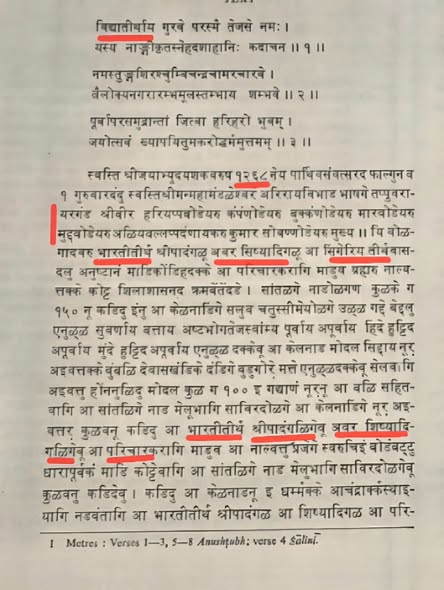
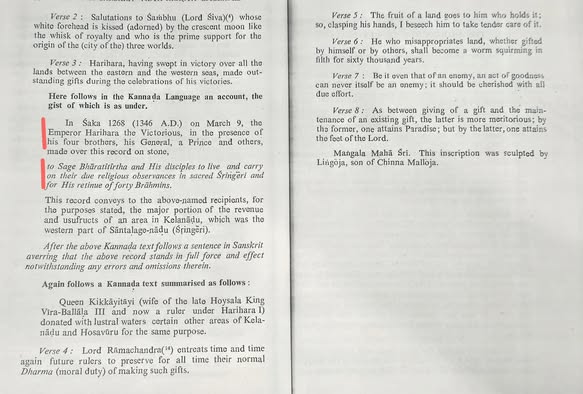
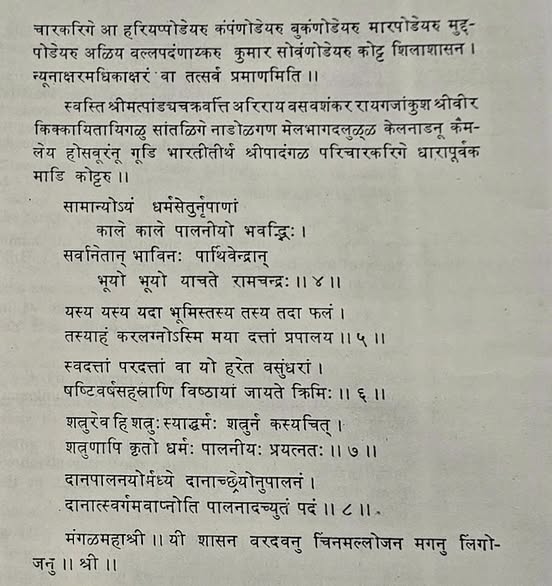
The 1346 C.E. inscription of Emperor Harihara I, recording a land grant to Shri Bharati tirtha Shripada, names only Shri Vidyatirtha and Shri Bharati tirtha, but does not mention Shri Vidyaranya at all.
If Shri Vidyaranya had indeed become an ascetic by1331 C.E., his name would have been mentioned in the very first royal grant record at the sacred (Tunga)Sringeri tirtha.
Hence, the oft-repeated date 1331 C.E. for Shri Vidyaranya’s initiation need not be accepted as historically correct.
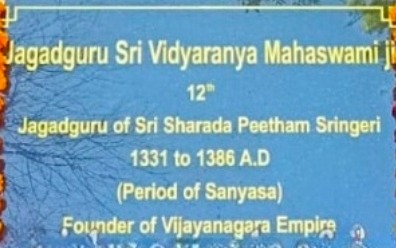
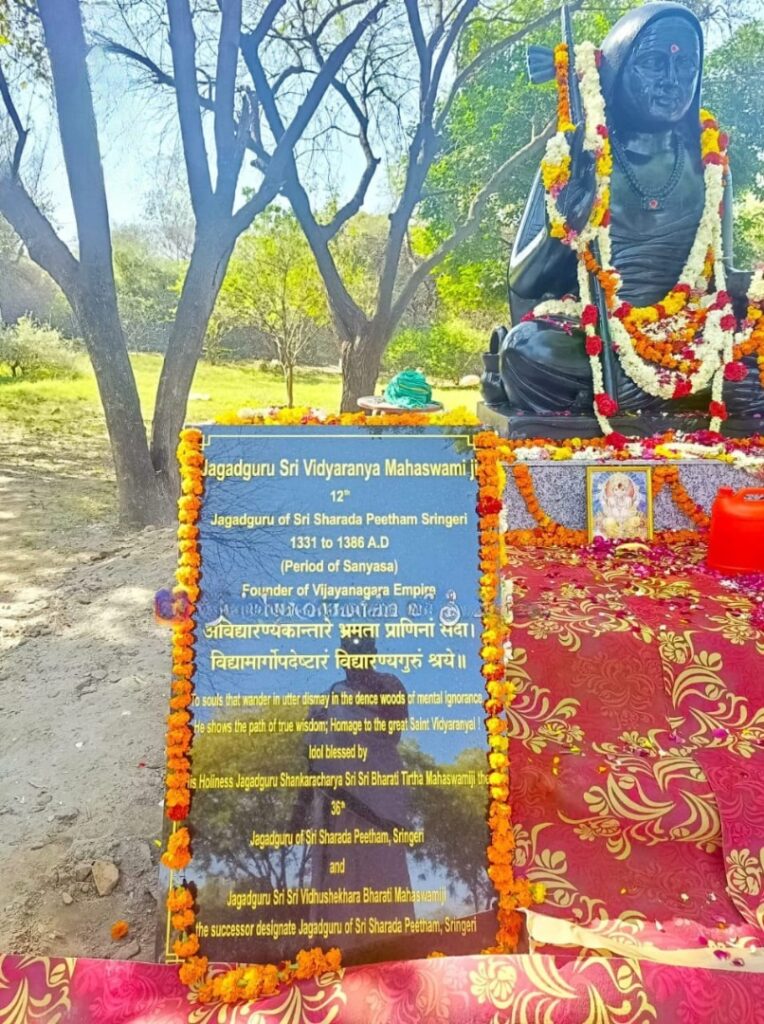
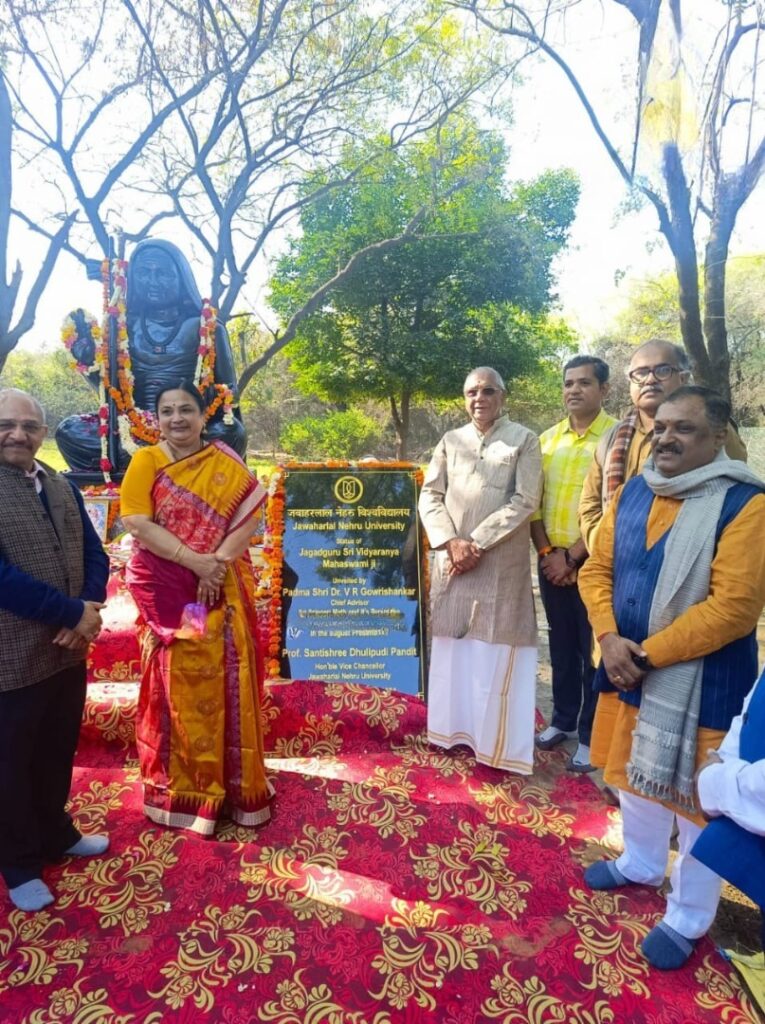
We chanced to see these images.
The plaque mentions both the period of Shri Vidyaranya Swami’s Sannyasa and the year of his Samadhi. We request scholars and researchers to clarify whether these details align with historical records and established tradition of the Shankarite Institutions of Southern India.
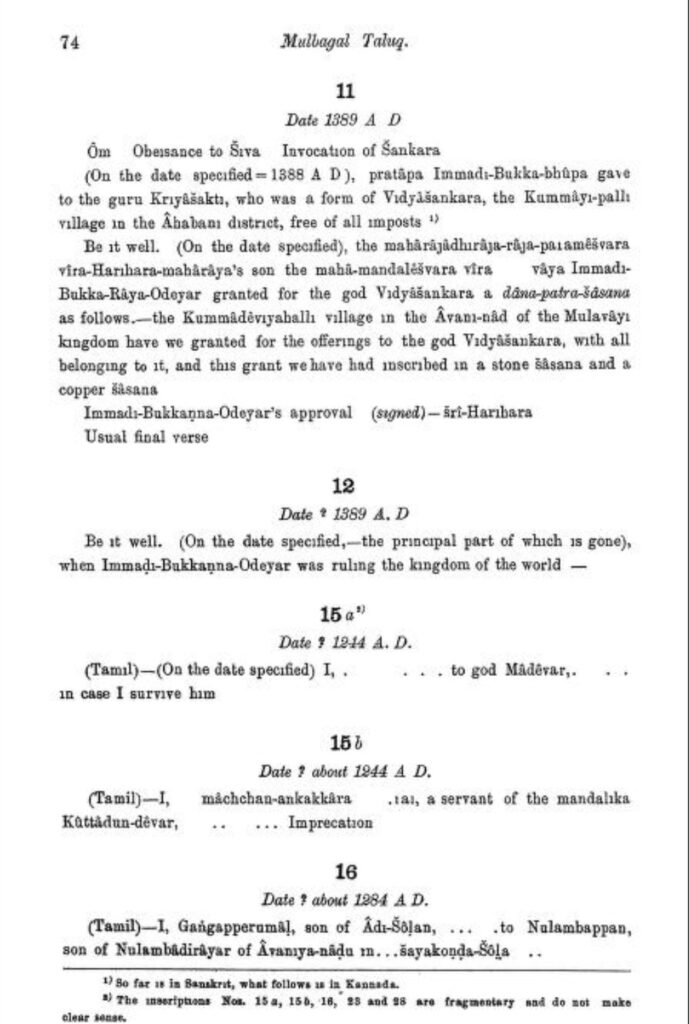
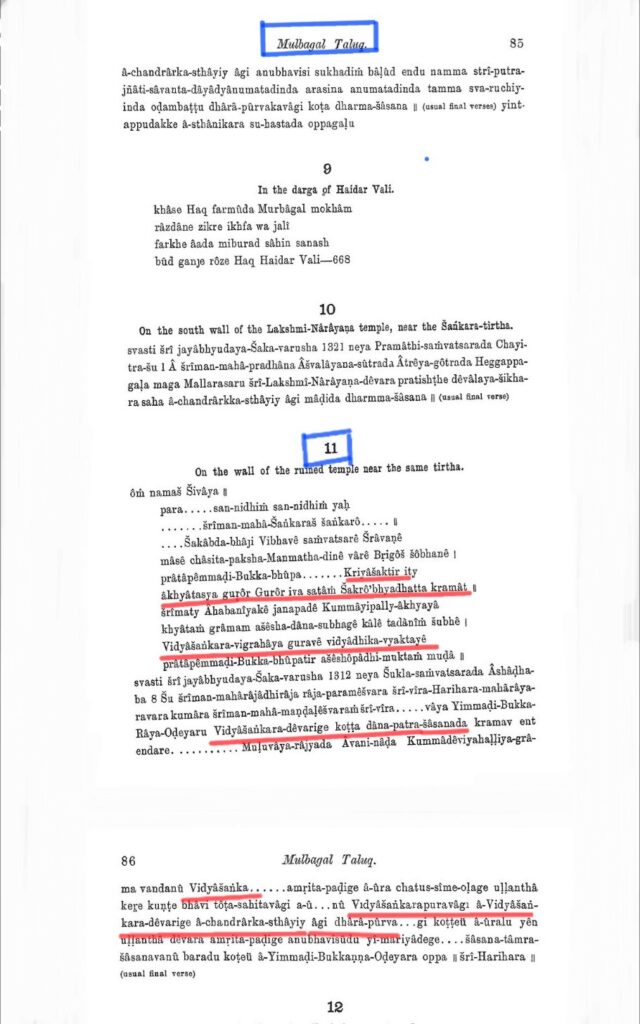
This inscription discovered in the Lakshminarayana temple near Shankara tirtha in mulbagal, Karnataka makes it clear the Vaidika Pashupata Acharya “Kriya Shakti”, the rajaguru of Vijayanagara empire, was also revered as “Sri Vidyashankara Devaru”.
The line “Vidyashankara vigrahaya Gurave Vidyadhika Vyaktaye” denotes that the Acharya took the divine form after his Siddhi and thus venerated as “Vidyashankara”.
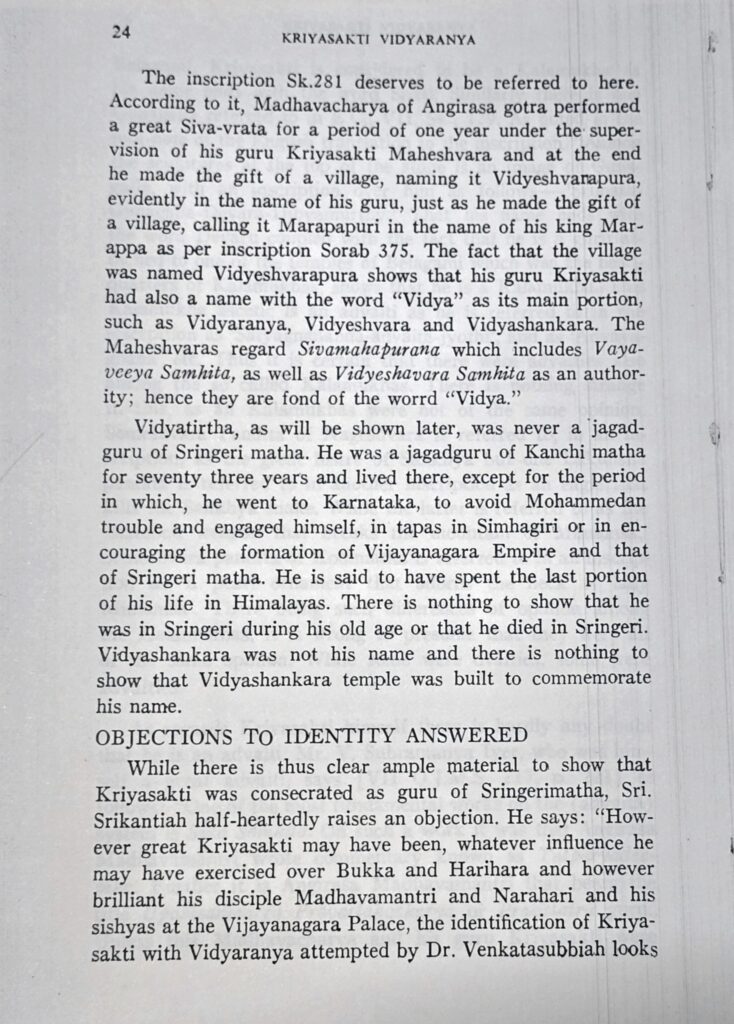
Eminent historian Shri. Dr.Venkatasubbiah says the words ” Vidyadhika – Vyaktaye” denotes Vidyaranya. However, Narasimhachar opines that it denotes Vidyatirtha himself, which is not correct.This is also inconsistent with the tradition since the Acharya belonged to the Kanchi matha who had attained Samadhi in Himalayas, long back.
Therefore, T.N.Mallappa in his book KRIYASAKTI VIDYARANYA supports the first interpretation, holding the Pashupata Shaiva Rajaguru Kriyashakti deva was consecrated as “Shri Vidyaranya” assuming that his divine form “Shri Vidyashankara” after his demise.
He also notes that according to Tunga Sringeri matha’s Guruvamsha Kavya, King Bukka built the temple to commemorate the name of Vidyaranya as he cured him of a disease.
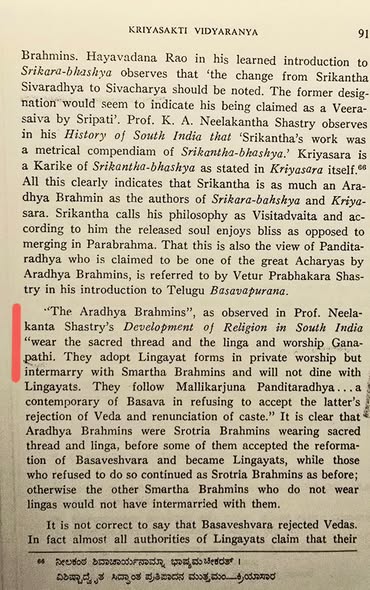
Prof.K.A.Neelakanta Sastri says, the Aradhyas of northern circar, Cuddapah, Kurnool and Mysore wear the sacred thread and the linga and worship Ganapati.
The Aradhyas follow the Shuddha-Shaiva-Amnaya tradition.
The Virashaivas claim that Revanna Siddha maha Yogi, their Preceptor, gifted Shankaracharya the Ratnagarbha Ganapati and Chandramouleeshwara linga murtis, citing the Guruvamsha-kavya of the Tunga Sringeri Matha.
This similarity of worshiping Shivalinga and Ganapati together like the Aradhya Brahmins tradition naturally raises a question in the minds of researchers :
Who actually gave these murtis?
Note: The Shivarahasya, Anandagiri’s Shankaravijaya, Markandeya Samhita and other traditional sources mention only the five Chandramouleeshwara sphatika lingas brought by Shankara Bhagavatpada.
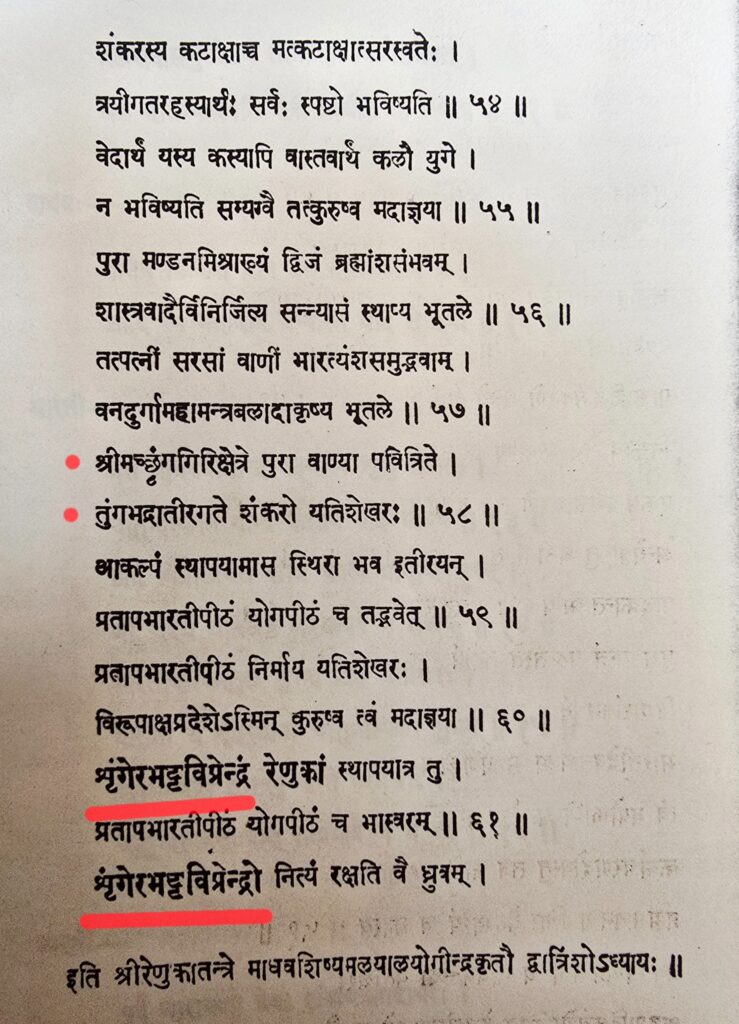
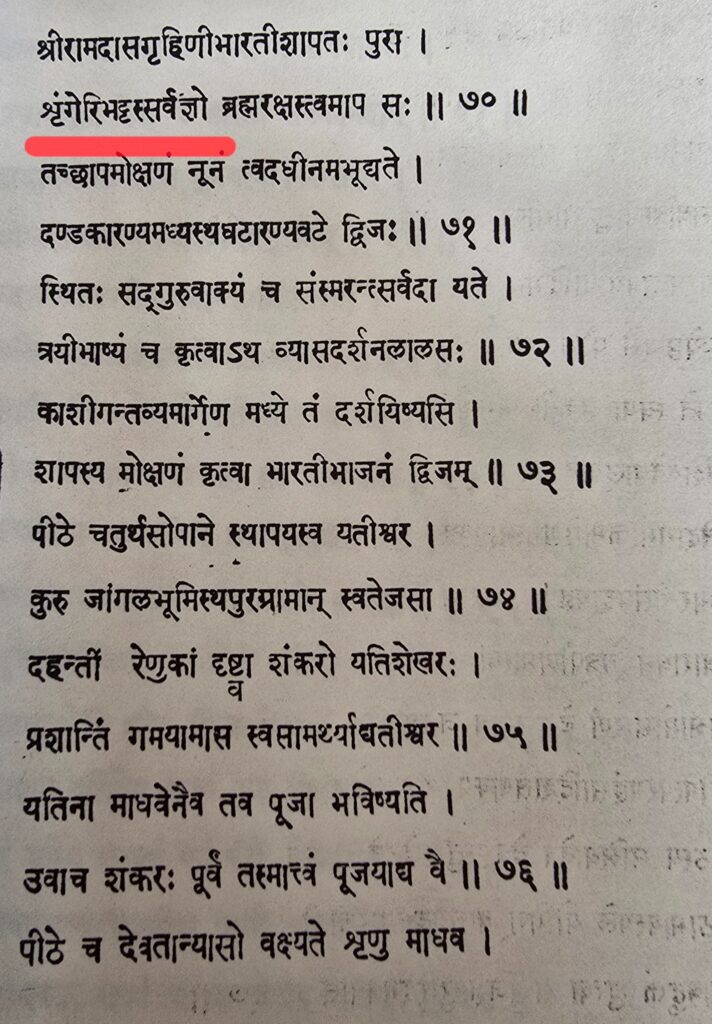
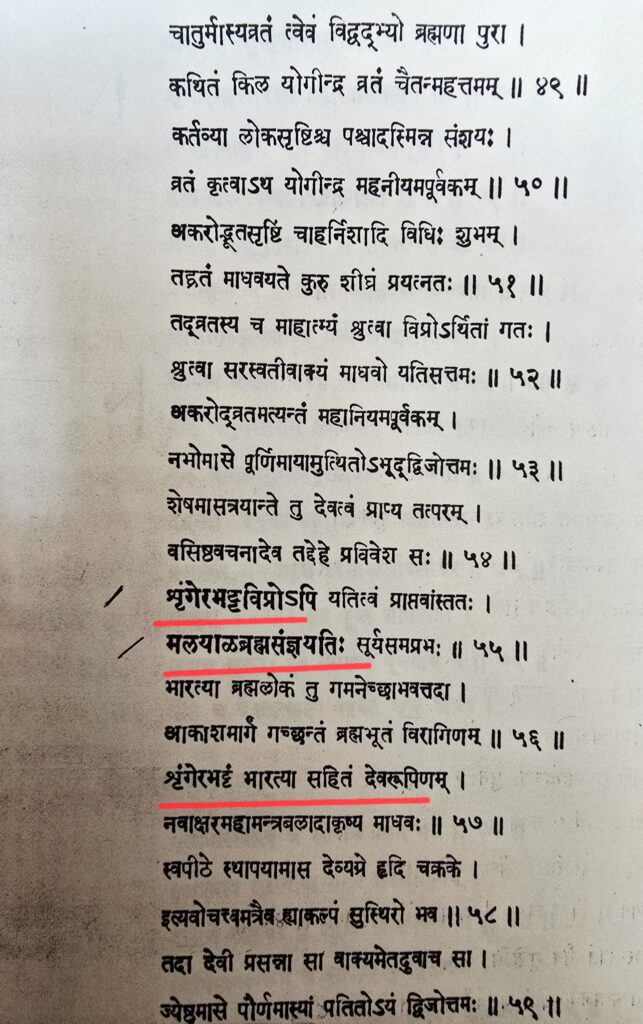
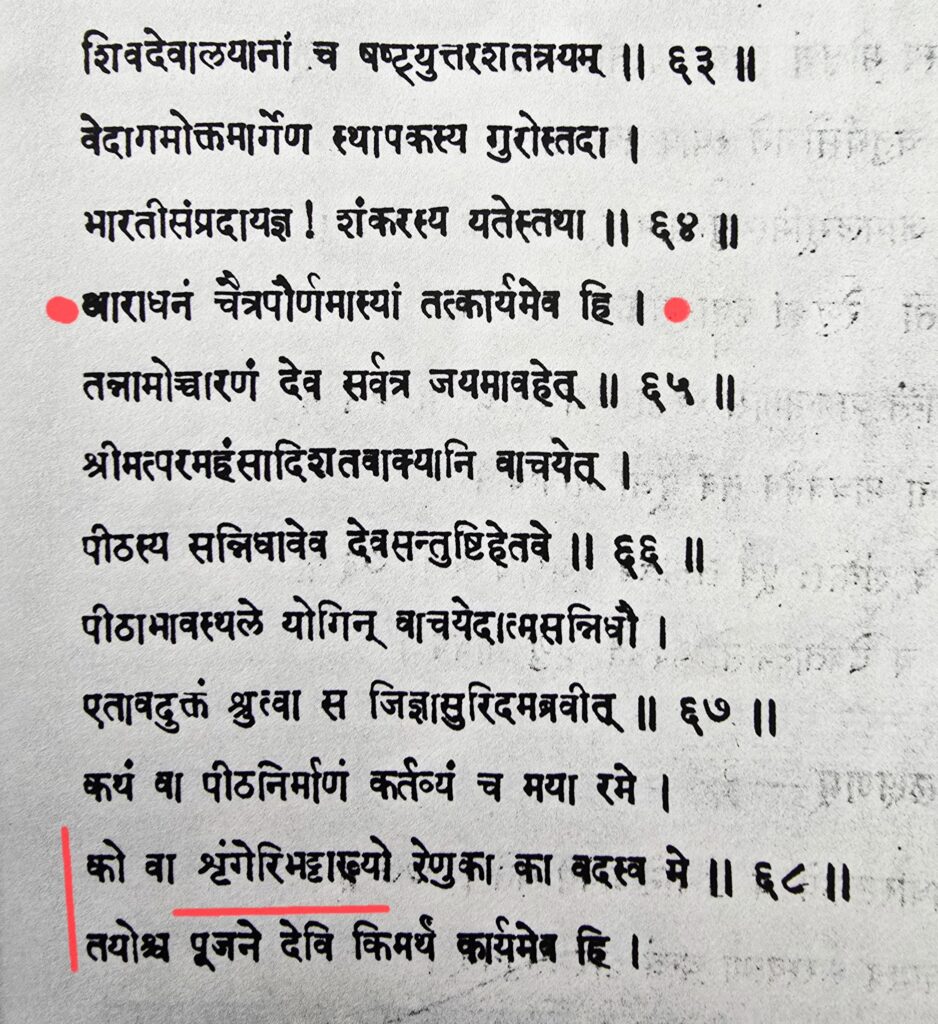
Even though it is said, the names Sringa-pura, Sringa-giri or Sringeri arose from their connection with Sage Rishyasringa, the literary and historical evidence, as well as the religious practices in the Mathas of Sri Vidyaranya Swami’s lineage, suggest otherwise.Not all the Mathas under this lineage have any hermitage of Rishyasringa in their vicinity, but all of them have shrines or worship places specially dedicated to Sringin- Malayala Brahman.Hence, it is most probable that all these places identified with the suffix “Sringeri” were originally named after Sringin, the Malayala Brahmana, who assisted and was initiated by Sri Vidyaranya Swami.Over time, through linguistic change and popular belief, the name might have become connected with Rishyasringa, whose ashrama, as pointed out in the Srimad Valmiki Ramayana and the Mahabharata, is situated in Anga Desa, the region of modern Assam or its borders.Images: from Chapters 32 and 33 of the Renuka Tantra